
Why backlogs fail before the first sprint


Every team that struggles with sprint planning eventually arrives at the same fix: better grooming. More refinement ceremonies. Clearer story templates. A stricter Definition of Ready. New required fields in Jira.
It rarely works. Not because those things are wrong - they're reasonable responses to a real frustration. They don't work because the problem isn't in the backlog.
The backlog is a receipt. It records decisions that were made somewhere else, by someone, at some point before grooming started. You can redesign the receipt all you want. That doesn't change what was purchased.
The symptom that looks like the problem
Teams with struggling backlogs follow a familiar script. Discovery happens informally - stakeholder conversations, Slack threads, a Confluence page nobody finished. A product owner synthesizes what they heard into a list of features. That list enters Jira. Then the team tries to refine it.
Refinement is where the pain surfaces. Stories arrive with open questions. Acceptance criteria are absent or too vague to test. The team spends a third of every session negotiating scope that should have been settled weeks earlier. Nobody's sure what "done" means for the most important story on the board.
Retrospectives produce predictable action items: "We need better stories coming into grooming." "Let's add a Definition of Ready." "Stories need acceptance criteria before sizing." All reasonable. All downstream.
What teams are diagnosing as a documentation problem is a decision problem. Documentation fixes don't fix decisions.
Where decisions actually get made
Two types of decisions shape a backlog, and they don't belong in the same tool.
Decisions about what to build and why are product decisions. What user problem are we solving? What does success look like? What scenarios does this feature need to handle? These require thinking, not tracking. They belong upstream, before anything enters Jira.
Decisions about how to organize the work are execution decisions. Which epic does this story belong to? What's the target milestone? Who owns it? These belong in Jira.
Most backlog problems are product decisions that arrived in grooming unresolved. The team is being asked to groom something that hasn't been thought through yet. That's not a workflow failure. It's a timing failure - and a responsibility one. The product owner, product manager, or requirements engineer is the person accountable for arriving at refinement with prepared decisions, not open questions. A PO who arrives at grooming with unresolved scope has, unintentionally, delegated product thinking to the development team during a ceremony that wasn't designed for it.
The two diagnoses point to different fixes. Teams that misidentify the source apply process at the wrong layer - and the problems stay.
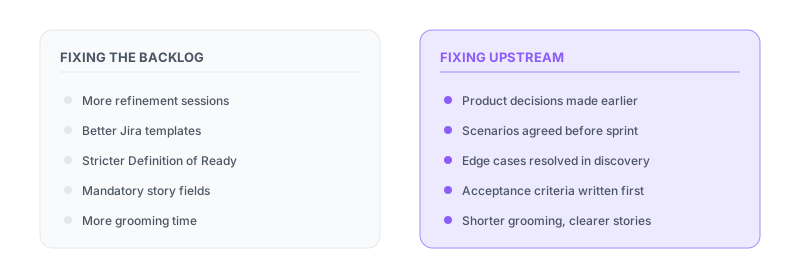
The same backlog problem, two different diagnoses. Teams on the left apply more process at the wrong layer. The right column addresses the cause - but requires work that happens before Jira is opened.
Decision debt
"Technical debt" exists as a concept because engineers gave it a name. There's no equivalent term for unmade product decisions, so teams don't see them accumulating. They just feel the weight in grooming.
Call it decision debt. It compounds the same way - quietly, across sprints, until it surfaces as a session that runs an hour over, a sprint that slips, or a feature that ships and gets rejected.
Session length is one signal. The longer a refinement runs, the more upstream work is happening in the wrong room. When a developer asks "what should happen if the user does X?" in a refinement session, that question should have been answered two weeks earlier. It's being answered now, under time pressure, by committee. Whatever gets decided is a guess everyone privately knows is a guess.
Rework is another. The story was clear enough. Development started. Three days in, an edge case surfaces that the team never discussed. The sprint slips. Post-mortem: "We should have spec'd it better." True - but the time to spec it was before the sprint started, not during it.
The one that stings most: the feature ships, it works, and the stakeholder says it's not what they meant. Both things are true. The developer built exactly what the ticket described. The ticket described something underspecified. The gap was there from the beginning - it just became visible at delivery.
Same failure, three different stages. The cost at each stage is higher than the one before.
Earlier doesn't mean upfront
The natural objection: continuous discovery already solves this. Keep discovery running in parallel with delivery. The Scrum model goes further - it explicitly treats refinement as a space where discovery should happen, a place to surface unknowns and align on scenarios as the team goes.
The theory sounds right. The practice creates a specific problem: it puts discovery and execution in the same cognitive space.
A refinement session already asks the team to shift attention from what they're building this sprint to what they'll build next. Adding unresolved product questions to that mix means context-switching mid-ceremony - between implementation details on current work and open-ended scope questions on future work. Sessions get longer. The quality of both kinds of thinking goes down. In high-pressure phases, it's one of the more reliable ways to slow a team down without anyone being able to say exactly why.
None of this means product thinking has to happen in a big upfront phase. It doesn't. It can be fully iterative - a product owner works through scenarios for one story while the previous one is in development, closes edge cases for the next epic while the current one is in testing. The cadence can be continuous. What changes is where it happens: not in the grooming room, and not by committee.
Continuous discovery gets the cadence right. The "discovery in refinement" model gets the venue wrong. By the time a story reaches grooming, the person accountable for the product decisions should have a concrete picture of the intended behavior. Not a perfect spec. A considered one.
What earlier actually looks like
Take the question "what happens when the user enters an email address that already exists?" That question will be answered somewhere in the process. The only variable is where.
If the product owner resolves it in discovery, it takes ten minutes. The decision is recorded. The story is clear before refinement starts.
If the team resolves it in grooming, it takes thirty. Half the answers are guesses. The product owner needs to check with a stakeholder. The story gets bumped.
If the developer resolves it alone during a sprint, the rest of the team doesn't know what was decided until review - or until a bug report.
The conversation is the same in all three cases. The cost is not.
Teams with clean grooming sessions aren't running better grooming sessions. They've done the thinking earlier. The product owner describes features in terms of user behavior, not system functionality. Acceptance criteria exist before the story title is finalized. The edge cases - what happens in the normal case, the failure case, the boundary case - were argued over before anyone opened an IDE.
None of that requires a new tool or a new ceremony. It requires one person - the product owner, the product manager, the person accountable for the product decisions - to do the thinking before the sprint starts, not during it.
The question worth asking
Backlog hygiene fixes keep failing because they address the output of a broken process, not the process itself. The backlog captures what the team has decided. If the decisions were incomplete, the backlog reflects that - faithfully.
Adding Jira fields doesn't help. The field is there. The decision behind it isn't. The team writes something because the field requires it, not because the question was answered. The form is complete. The thinking isn't.
The useful question isn't "how do we improve grooming?" It's "at what point in our process do product decisions actually get made - and are they getting made well?" That question usually reveals decisions being made informally, late, in the same refinement session being blamed for taking too long.
Refinement is a good process for teams that have done their discovery. For teams that haven't, it's where discovery happens - with a sprint deadline attached.
The backlog can't be fixed in the backlog. The work is upstream, and most teams haven't started it yet.

Requirements Engineering for modern Software-Teams
Better grooming doesn't fix a backlog full of unmade decisions. This course covers where those decisions actually need to happen - before Jira, not in it.
View the course