
User stories are monologues. That’s why your refinement keeps breaking.

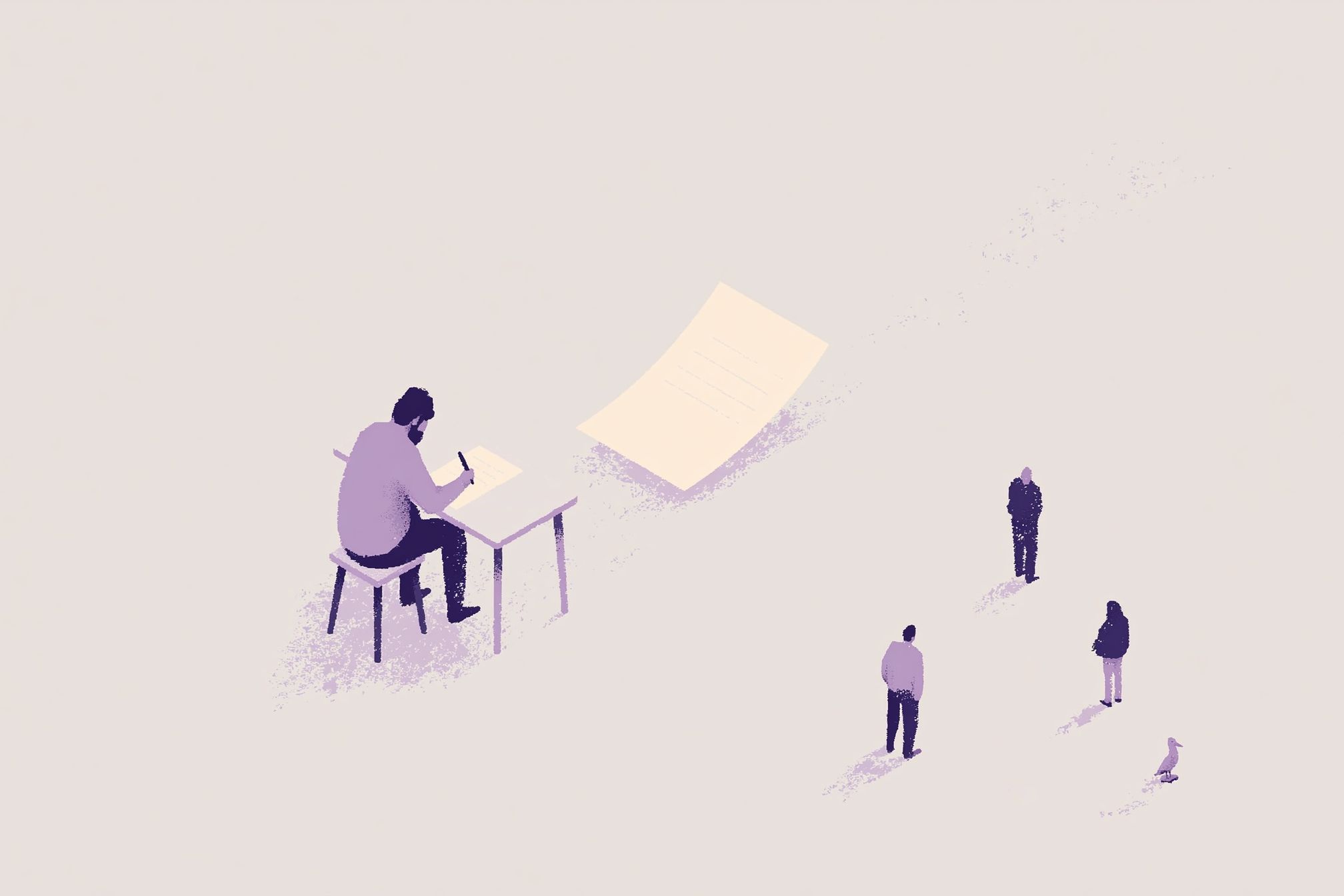
Every team has a version of this meeting. The story goes into refinement looking complete - title, description, three acceptance criteria. Someone asks a question. Then another. Someone says "I think we need to split this." Forty minutes later, you're debating scope instead of pointing.
The team writes better stories next time. It happens again.
Most teams read this as a quality problem. The stories weren't specific enough. The acceptance criteria were too vague. The template needs another field. They run story-writing workshops. They circulate examples of "good stories."
The stories still get torn apart in refinement.
The format is the problem. Not the quality. And not just how teams happen to misuse it. Even stories written carefully by experienced POs produce this pattern. The monologue is structural, not incidental.
The "As a user" sentence does one thing well
The standard user story template (As a [role], I want to [action], so that [benefit]) was designed with a specific corrective purpose. Requirements documents of the late nineties were full of system-centered language: "the system shall process payments," "the module will validate input." The user story format shifted attention toward the person using the system and the outcome they cared about.
That correction worked.
The problem is that teams took the sentence and made it the artifact. The story went from being a placeholder for a conversation to being the conversation itself. Alistair Cockburn, who coined the phrase in 1998, described a user story as "a promise for a conversation," not a substitute for one. That distinction got lost somewhere between certification courses and Jira ticket templates.
The format was always a starting point. Teams turned it into a deliverable.
What the format does to information flow
Think about what the structure actually produces. One person, usually the Product Owner, sits down and writes. They fill in the fields. They capture their model of what the user needs and save the ticket.
Then the developer reads it. Then the QA engineer reads it. Then, in refinement, they ask the questions the PO didn't know they needed to answer.
That's a monologue with a delay built in.
The format doesn't invite contribution. It invites reaction. And reaction happens after the model is already set. Raising questions at that point means implicitly acknowledging that the first version was incomplete. That social friction is real. It's one of the reasons refinement conversations have a particular texture: people speak carefully around the story, rather than directly about what it's missing.
The obvious objection is that the format was intentionally brief, precisely so that teams would be forced to have the conversation the card couldn't contain. That logic holds up in theory. In practice, a field that has been filled signals completion. The PO hit save. The ticket moved to "ready." The implicit message to everyone else in the system is: this is done. Asking questions requires someone to reopen what was closed. Most people don't.
This isn't a failure of the people using the format. It's a structural outcome of the format itself. A form with fields trains you to fill the fields. Check them off, and the story is "done." The story was never done. It was one person's model, waiting to collide with two others.
What refinement is actually repairing
When a story gets pulled apart in refinement, teams usually blame one of three things: the PO didn't know the domain well enough, the developers didn't read the story before the meeting, or the acceptance criteria were too vague.
All of those might be true. None of them is the root cause.
The useful distinction here is between decisions documented and decisions that still need to be made. A user story documents one person's decisions. But the decisions that actually matter are ones nobody has made yet: what happens at the edge cases, how the system behaves when something goes wrong, which users this even applies to. Those decisions live at the intersection of the PO's intent, the developer's constraints, and the QA engineer's model of how things break.
No single person holds that intersection.
What refinement is doing, when it works, is constructing shared understanding that the format assumed was already there. The story goes in as one person's model. It comes out as the team's model. That process takes time because it should. Three people with three different versions of the same feature don't get to a shared one quickly.
The issue isn't that refinement is inefficient. The issue is that the format puts all the thinking upstream, assigns it to one person, and then surprises everyone when the models don't match.
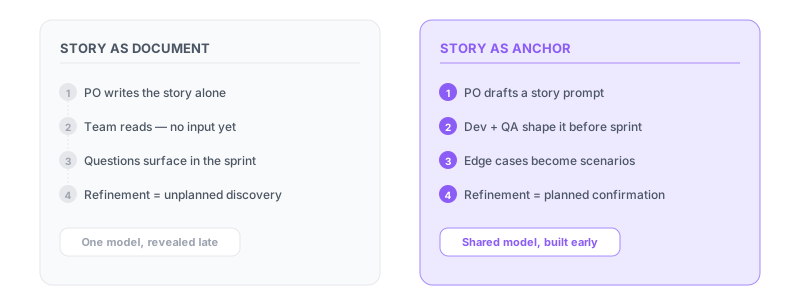
The process looks the same from the outside: a story, a refinement meeting, a sprint. What changes is when the three perspectives in the room got to meet each other.
A story is not the output. It's the starting point.
Think of it this way. A story written in isolation is like a meeting agenda drafted by one person without asking the other attendees what they need to discuss. It captures what that person thinks matters. It doesn't account for what the others in the room actually know, disagree about, or need to decide.
The agenda gets rewritten in the first five minutes. Always.
The right use of the story format is as a starting point for a structured conversation. Typically a Three Amigos session, where the Product Owner, a developer, and a QA engineer work through the story together before it enters the sprint. The acceptance criteria get written in that room. Edge cases turn into scenarios. The story that lands in your backlog reflects the team's shared model, not one person's draft.
The format stays the same. What changes is who contributes to it and when.
This is the structural shift: from "the PO writes the story and the team reads it" to "the PO drafts a prompt and the team builds the story together." The ticket in your backlog looks identical. The process that produced it is different in every way that matters. Stories move through the sprint without stopping for answers that should have been agreed two weeks earlier.
The question the format can't ask
There's a specific category of information the standard format always leaves blank: the unhappy path.
Consider this story:
As a user, I want to reset my password so that I can access my account if I've forgotten it.
Three acceptance criteria: the user receives a reset email, the link expires after 24 hours, the password updates on submission. It looks complete.
What happens if the email address doesn't exist in the system? What does the user see? What if the link has expired - clear error, or a generic failure page? What if the new password doesn't meet complexity requirements, and the form doesn't say so before submission?
None of those questions fit in the format. The format is structured around intent: what the user wants, why they want it. Behavior lives somewhere else. The edge cases, the unexpected states, the system's response when something goes sideways. In someone's head. Or in the sprint, when it's too late to be cheap.
A developer making those decisions alone isn't doing something wrong. They're filling the gap the format created.
When a PO, a developer, and a QA engineer sit with that story before the sprint and ask "what happens when...," those questions surface in ten minutes. They become written scenarios - Given the email address does not exist / When the user submits the reset form / Then they receive the same confirmation message, without revealing account existence. Written before anyone opens an IDE. Agreed before anyone starts building.
The decision still gets made. The difference is who makes it, and when.
The artifact isn't the problem. The artifact-first process is.
A user story is a compression format. One person encodes their model of a feature into a set of fields. When the rest of the team reads it, they decompress - checking the story against their own version of what that feature means, looking for what doesn't add up.
Refinement is the decompression session.
When decompression happens during sprint planning, a mismatched model costs a blocked developer, a Slack thread that shouldn't exist, and a story that slips. When it happens before the sprint, in a conversation with the people who will build and test the feature, it costs an argument in a meeting.
Most teams try to fix the compression. Better templates. More required fields. Clearer guidelines for what "ready" means.
The compression was never the problem. The timing of the decompression is. Write the story with the team, and refinement becomes a ten-minute confirmation. Write the story for the team, and refinement becomes the place where the real requirements work finally happens - just at the worst possible moment.

Requirements Engineering for modern Software-Teams
A story written alone is a monologue with a delay built in. This course covers how to make refinement a confirmation, not the first real conversation.
View the course