
The short version
GSD Core gives you
A five-step loop for each phase of a milestone: discuss, plan, execute, verify, ship. The heavy research, planning and execution run in fresh-context subagents, so your main session stays lean. State files survive between sessions, it installs for many runtimes, and it is MIT licensed.

 Speclr gives you
An AI that interviews your team through discovery, exploration, planning and refinement, and ends with user stories and Gherkin scenarios an agent can build from. It runs in your browser, with the AI included.
GSD Core is about building reliably. Speclr is about knowing what to build.
What GSD Core is good at
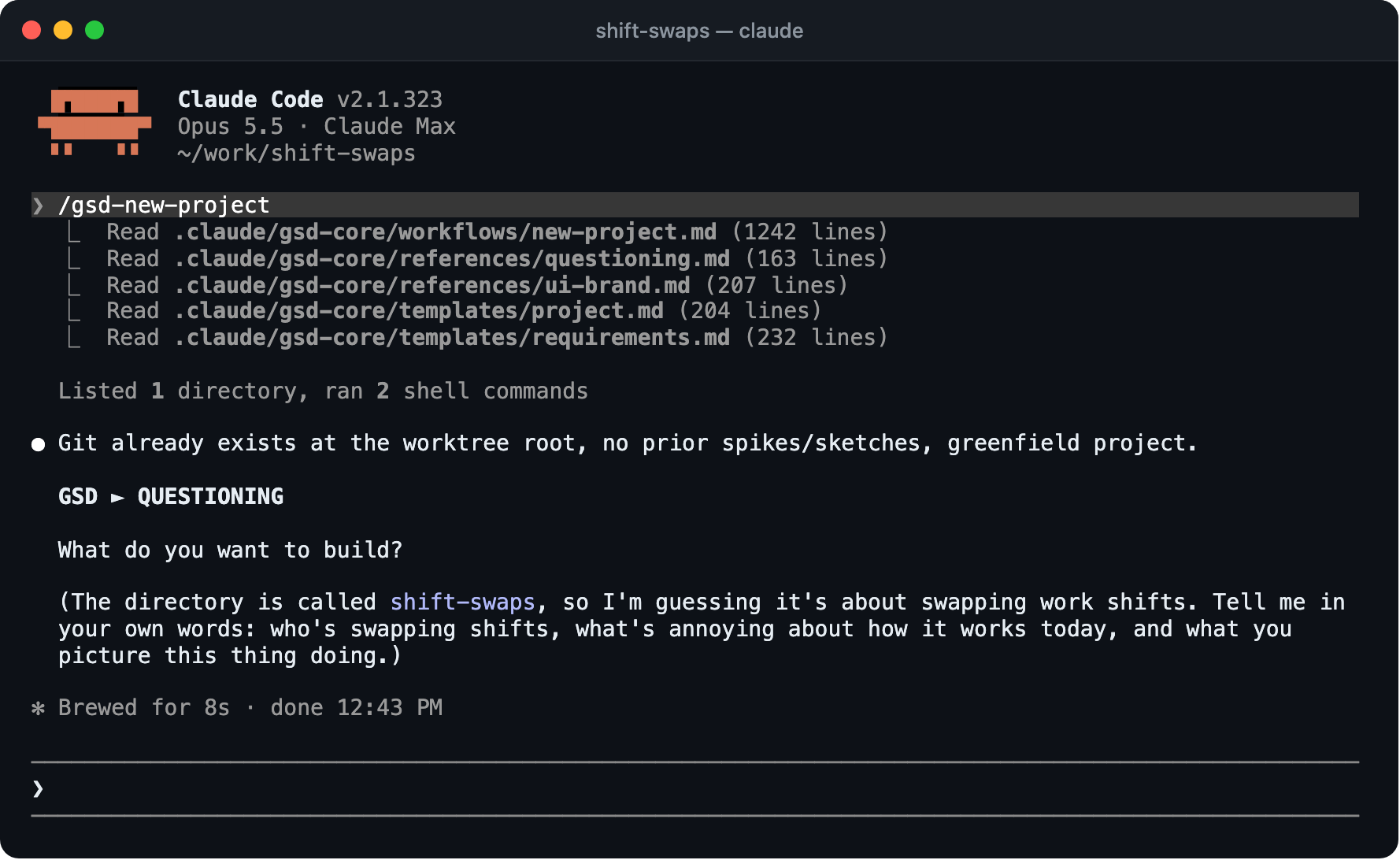
GSD Core targets context rot, the drop in quality that builds up as an agent fills its context window. Plans run in parallel waves, and each executor starts with a clean context of about 200k tokens. A verify step walks through what was built and produces fix plans before a phase counts as done, and the ship step opens the pull request. It has a command for starting a new project and one for onboarding an existing repository, and it works with Claude Code, Codex, Cursor, Copilot and others.
GSD started as the get-shit-done repository. That repository was archived in June 2026 and points to GSD Core, which continues in the open-gsd organization.
Where it gets hard when requirements belong to more than one head
Say your team is building shift-swap requests for a retail chain. The store manager knows how swaps work in practice, the works council has rules about notice periods, payroll knows what a swap does to the hours, and a developer starts the loop.
The discuss step captures implementation decisions with the person driving the session. The rules that only the store manager and the works council know have to reach that person first, and from then on they are the developer’s summary. GSD Core is built to keep the agent on track once the decisions are made, and it does that well. It does not claim to be the place where those decisions are made by the people who own them.
What Speclr does instead
- The AI asks, the people answer.The store manager, payroll and the developer answer in the same project, and conflicts between their answers are surfaced and resolved there.
- Your material comes in.Upload meeting notes, documents or photos of workshop results. Speclr extracts and classifies the content, and the team goes through it together in Review Files before anything is worked in.
- Contradictions and risks surface early.Contradictions in the domain knowledge are detected, and risks are identified and managed in the project.
- Few, agreed scenarios.User stories with a handful of Gherkin scenarios each, short enough for the store manager to read and approve.
- Out into your tools, progress back.Speclr exports the spec into your SCM, ticket system or wiki, or as a download for your agent, and reads implementation progress back from issue and branch states.
Where GSD Core is stronger
- It builds. Plans run in parallel waves in fresh contexts, a verify step checks the result, and the ship step opens the pull request. Speclr follows progress but does not build.
- It manages the agent’s context across a whole milestone. Speclr does not.
- It has an onboarding command for existing repositories. Speclr offers no tooling for existing codebases today: it does not read or analyze your code.
- It is free, needs no account, and works with many runtimes.
Use both
The two do different jobs, so combining them is natural: Speclr settles what to build with the team, and GSD Core’s loop builds it. Speclr’s export (issues or files in your repository) is what the loop’s discuss and plan steps can start from.
GSD Core is free. Why pay for Speclr?
GSD Core is free and open source, and you pay for the agent and models you run it with. Speclr starts at $29 a month, billed annually, with the AI usage for the spec work included. You pay for the step that GSD Core does not cover: several people, not all of them in a terminal, agreeing on what the agent should build.
| What is compared | GSD Core | Speclr |
|---|---|---|
| Price | Free, MIT licensed. You pay for your coding agent. | From $29 a month, billed annually. AI usage included in the plan. |
| Main job | Run the agent through discuss, plan, execute, verify and ship, with clean context. | Get the team to a refined spec. |
| Where it runs | Inside your coding agent, in your terminal. | In your browser. |
| Who answers the questions | The person driving the session. | The people in the project. |
| What you get | Plans, state files and a shipped pull request. | User stories and Gherkin scenarios, plus a Markdown mini-PRD. |
| Building the code | Parallel executors and a verify step. | Not offered. Progress is read back from issue and branch states. |
| Existing codebases | An onboarding command. | No tooling support today. Documents, notes and photos come in through Review Files. |
Questions
Only partly. Both call themselves spec-driven, but GSD Core runs the build and Speclr gets the team to the spec. Many teams will want both.
Last updated 13 November 2026. GSD Core details from its README and the archive notice of the original repository, checked 13 November 2026. Found something out of date? Tell us at contact@speclr.dev.