
The short version
OpenSpec gives you
Slash commands for your coding agent: explore an idea, propose a change, apply it, archive it. Each change gets a folder in your repo with a proposal, specs with scenarios, a design and a task list. It is free, MIT licensed, and works with more than 30 coding tools.

 Speclr gives you
An AI that interviews your team through discovery, exploration, planning and refinement, and ends with user stories and Gherkin scenarios an agent can build from. It runs in your browser, with the AI included.
Both want agreement before code. They differ in who takes part and where the work happens.
What OpenSpec is good at
OpenSpec keeps the process loose: there are no phase gates, and any artifact can be updated at any time. It is built for existing codebases as much as for new ones, because a change is recorded as a delta against a persistent spec. Thoughtworks moved it to Trial in its November 2026 Technology Radar and named that spec-anchored approach as its main difference from other tools. For teams, a beta feature called Stores keeps planning in a repository of its own, shared with git, so a feature that spans several repos has one plan.
Where it gets hard when requirements belong to more than one head
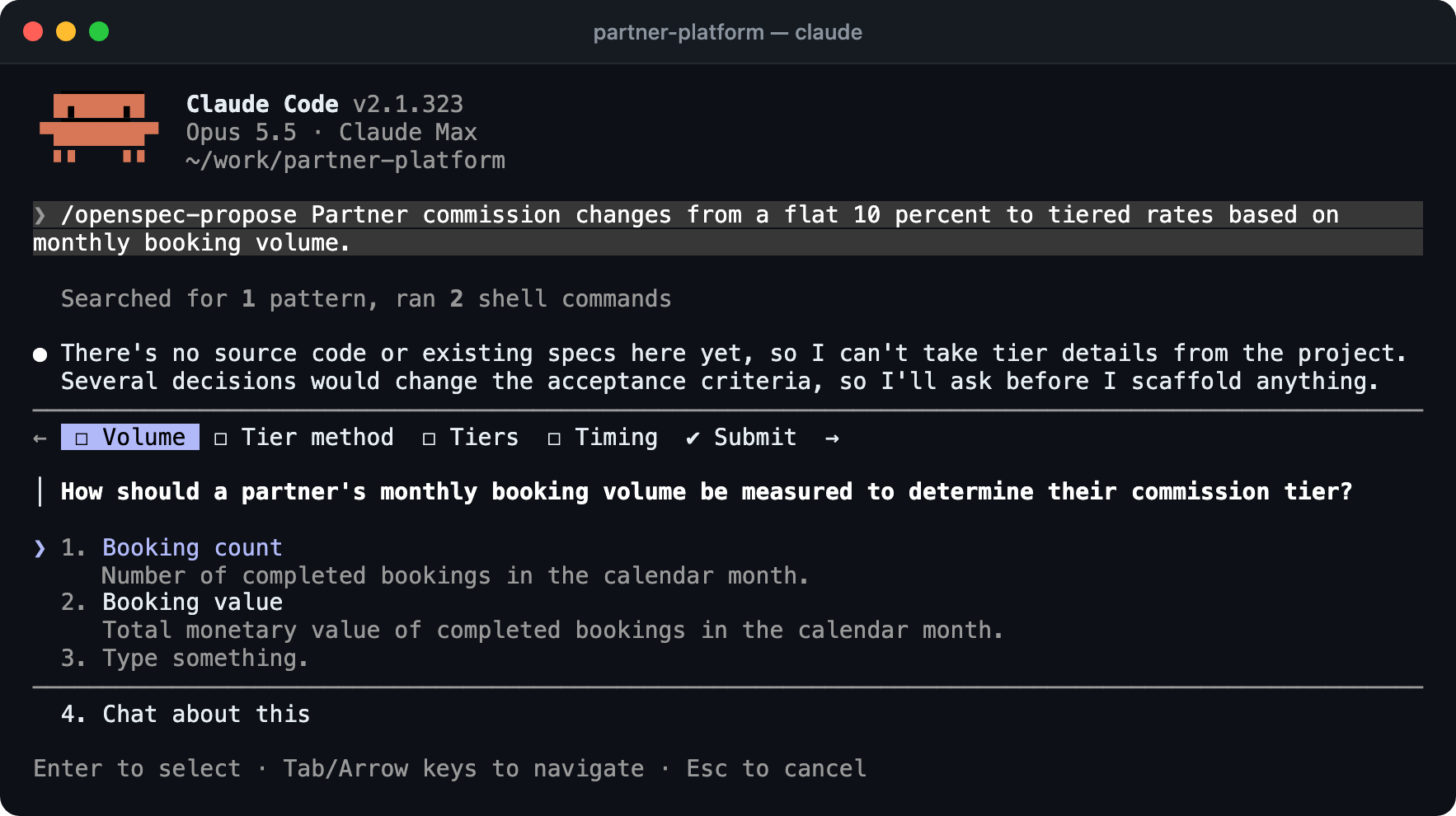
Say your team is changing the commission rules of a partner platform. The sales lead knows what was promised to partners, finance knows what the booking system can book, and a developer runs the first command.
OpenSpec’s AI writes the proposal and the scenarios, and the person in the session reviews the plan before any code is written. That person is the developer, so the commission rules reach the spec through the developer’s reading of them. Stores let developers share the plan through git. The sales lead and finance still have to find their way into a repository to correct what was written. Thoughtworks also points out that agents generate this kind of Markdown prolifically, and that keeping the persistent spec current takes discipline.
What Speclr does instead
- The AI asks, the people answer.Speclr guides the team through a discovery interview, exploration, planning and refinement. The sales lead and finance answer the questions themselves.
- One workspace for everyone involved.Product owner, developer and domain experts work in the same project and edit the same artifacts.
- Your material comes in.Upload meeting notes, documents or photos of workshop results. Speclr extracts and classifies the content, and the team goes through it together in Review Files before anything is worked in.
- Contradictions and risks surface early.Contradictions in the domain knowledge are detected, and risks are identified and managed in the project.
- Few, agreed scenarios.The result is user stories with a handful of Gherkin scenarios each, short enough for the sales lead to read and approve.
- Out into your tools, progress back.Speclr exports the spec into your SCM, ticket system or wiki, or as a download for your agent, and reads implementation progress back from issue and branch states.
Where OpenSpec is stronger
- It is built for existing code. It works from your repository and records each change as a delta against a spec that lives next to the code. Speclr offers no tooling for existing codebases today: it does not read or analyze your code. It takes in documents, notes and photos through Review Files.
- The spec lives in your repo and changes with the code. Speclr’s project lives in Speclr and is exported.
- It takes the change all the way through apply and archive. Speclr follows implementation progress but does not build.
- It is free, needs no account, and works with more than 30 tools.
- Stores (beta) let a team keep one plan across several repositories, shared with git.
Use both
Speclr’s export (issues or files in your repository) can be the starting point for an OpenSpec change.
OpenSpec is free. Why pay for Speclr?
OpenSpec is free and open source, and you pay for the coding agent and models you run it with. Its README notes that it collects anonymous usage statistics, with a documented opt-out. Speclr starts at $29 a month, billed annually, with the AI usage for the spec work included. What you pay for is the conversation that gets several people, not all of them in a repository, to one spec.
| What is compared | OpenSpec | Speclr |
|---|---|---|
| Price | Free, MIT licensed. You pay for your coding agent. | From $29 a month, billed annually. AI usage included in the plan. |
| Where it runs | Inside your coding agent, in your repo. | In your browser. |
| Who asks the questions | The AI, to the person in the agent session. | The AI, to everyone in the project. |
| Who can take part | Whoever works in the repo. Stores (beta) share planning through git. | Anyone you invite to the project. |
| What you get | A change folder: proposal, specs with scenarios, design, tasks. | User stories and Gherkin scenarios, plus a Markdown mini-PRD. |
| Existing codebases | Built for them, with spec deltas. | No tooling support today. Documents, notes and photos come in through Review Files. |
| After the spec | Apply and archive. | Export into SCM, tickets or wiki, with progress read back. |
Questions
For getting a team to the spec, yes. Speclr does not write code, so your agent still does that, with or without OpenSpec’s commands.
Last updated 13 November 2026. OpenSpec details from its README and the Thoughtworks Technology Radar, checked 13 November 2026. Found something out of date? Tell us at contact@speclr.dev.